

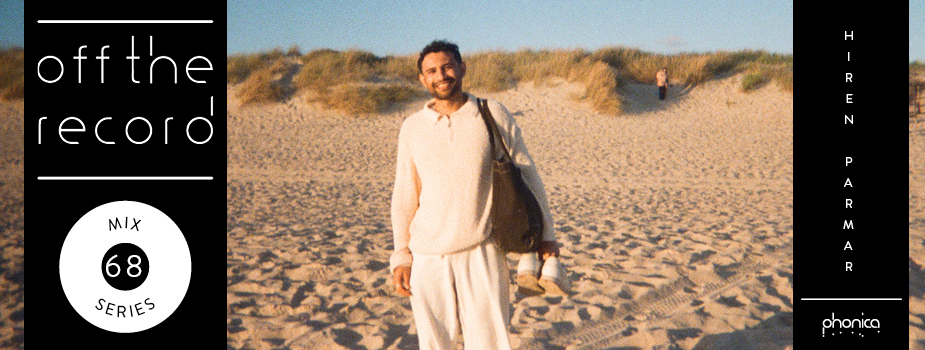
Hiren Parmar is a DJ, selector and senior programmer at Voices Radio, with a musical approach shaped by years of digging and an instinct for connecting sounds from far-reaching corners of the world. From his regular Small Moments Breakfast Show to appearances alongside fellow boundary-pushing selectors across London, his sets move freely between genres, united by a deep sense of curiosity and careful listening.
For his Phonica Off The Record mix, titled “A Postcard for a Dream,” Hiren takes that approach somewhere more introspective, building a slow descent into the subconscious through field recordings, ambient, folk, classical music, experimental electronics, spoken word and beyond. Opening among the woodlands of the English countryside and eventually arriving at the wild, thunderous landscapes of Japan, it’s a richly textured journey that feels less like a conventional DJ mix and more like slipping gradually into a vivid dream.
Hey Hiren, thanks so much for joining us! Can you tell us about your mix and the idea behind it?
Thanks for the invite! I’ve titled this mix “A Postcard for a Dream”. I wanted to capture and craft the intensity of a dreamlike state that builds and builds, mirroring the idiosyncratic parts of the self in dreams. But also I wanted to make a mix that slowly enters into the subconscious, perhaps something that could draw a listener into a visceral vivid sleep. I’ve been meditating and practicing Yin Yoga to ethereal downtempo music in the evenings to wind down and this mix definitely takes inspiration from that part of the day for me. A period of solace and quietness with the self.
I spent quite a lot of time finding a way to build the mix’s atmosphere and I started with a reading from a friend of the poem ‘Forest’ by Carol Ann Duffy with field recordings I’ve taken in the British countryside. The feels move from soft inviting warmth to something more offkilter, haunting, intense and full of rich texture. There’s definitely a feeling of ‘lowering/ being submerged into’ the mix into the space of deep listening. I love creating audio, field recordings and sound art and wanted to build a mix that pulled on those tenets, moving away from something beat matched and instead playing with textures and intensities.
Training as a therapist I’ve really sat with relational moods in group settings, feeling the general atmosphere in the room and the emotions embodied in myself and I suspect I’m also taking from these intense periods of emotional upheaval and translating them to this mix. As always with my djing, this mix moves through many genres and sonic worlds of field recordings, ambient, folk, classical, experimental electronica, spoken word, South Asian jazz, and Gnawa. Opening in the woodlands of England and closing with the expansive windows of Japan’s wild thunderous nature with Masakatsu Takagi’s softly improvised classical piano, the mix is rooted in global influences across counties, countries, and continents; India, Morocco, Sweden, Palestine, Srilanka, Japan, France, New York, California, London, Manchester and Yorkshire. Most genres are on the table for me, and I love the challenge of finding a way to make them make sense.
What are your preferred methods for finding new music? Do you still enjoy digging around in dusty crates, or do you prefer to buy online?
It’s about 60% in-store and 40% online. The dusty crate digs are one of my favourite places to be. I’m very happy to spend hours there searching for that one record to play out at a party or perhaps a stunning album at home. I play across a broad range of genres and I can be in most corners of a record shop looking anywhere and everywhere. Word of mouth is also so important. I’ve been put onto many releases and albums from chatting with friends, colleagues and musical lovers about recommendations. Discogs / Bandcamp will always be there when I need something I just can’t get anywhere else. Particularly records from abroad that only have a few copies available but I don’t rely on it only for my music digging. I’m trying to be mindful to still keep the tangible human connection with a record shop, the people behind the till and physical act of digging. Voices Radio is right by Honest Jons in Kings Cross and I’m in there all the time asking for recommendations. Building that relationship with the staff / owners of a record shop is really beautiful, and once they lock into my sound they often recommend all sorts of records I never would have found. I also spend a lot of time listening to the incredible mixes at Voices Radio and beyond. Radio is one of my favourite ways to connect to music. You can’t beat a presenter personally curating their own show for anyone to listen to. It takes dedication and time to make a radio show and I really respect the effort required to build a sound and curate a sonic voice.
You are one of the main faces behind the Voices Radio, how did that come about?
I knew one of the directors, Toby, from the Manchester days ~ 2016 when he used to run his party Ossia and I used to run my party up there. A few years ago I was looking for music / radio work and hit Toby up. I’m very grateful he sorted me out with an ad hoc shift at Voices and here we are a few years later. Luck also played a big role. I don’t want to understate it; the station didn’t have official programmers when I joined, and overtime the role was created for me within the team’s structure. Classic right place, right time situation.
What do you have up your sleeve for the rest of 2026?
Keeping this one hidden for now. Audiophile parties with friends and building an inviting playful atmosphere on the dancefloor will always be on the cards though!


